15 July 2026 · PIP Helper Team
How to describe “good days vs bad days” on a PIP form without losing points
Claimants with fluctuating conditions often torpedo their own claims by being too balanced. This guide teaches the language that’s both honest about variation and accurate to how the form is scored.
Key Takeaways
- The 50% rule scores the descriptor that fits you on most days - not your best day, not your worst.
- Vague language costs points. “It varies” reads to assessors as “occasional difficulty.” Specific frequency (“18 days a month I cannot…”) doesn’t.
- A good day with chronic illness is rarely a non-disabled day. Describe what good days actually look like - pacing, restrictions, post-activity cost.
- Activities completed once but not repeatedly fail the reliability test, even on good days.
- A symptom diary does the 50% calculation for the assessor; 6–8 weeks of consistent entries is the strongest evidence for fluctuating-condition claims.
If your condition fluctuates, you’ll have noticed already that the PIP form doesn’t quite know how to ask about you. The questions are written as if there’s a fixed answer - “can you cook a simple meal?”, “can you wash and dress yourself?” - when the actual answer is some version of “yes, but only on about a third of my days, and then I can’t do anything else for the rest of the day.”
This guide is about how to put that answer onto the form in a way the descriptors can score. Specifically, it’s about avoiding the most common failure pattern for fluctuating conditions: claimants describing themselves at their average or best, rather than where the rules actually want the answer.
The conditions where this matters most: ME/CFS, long covid, fibromyalgia, MS, bipolar disorder, IBD with flares, endometriosis, anxiety with panic episodes, and almost any chronic pain condition. But the technique is the same regardless of cause.
Why “I can do it on a good day” is a points-killing answer
If you remember one thing from this guide, remember this: the form isn’t asking what you can do at your best. It’s asking what describes you on the majority of days.
This is set out explicitly in the PIP regulations under what’s commonly called the 50% rule (covered in detail in our 50% rule guide). The shorthand version: for any descriptor to apply to you, it must describe your situation on more than 50% of days, over a 12-month period - looking back three months and forward nine.
The trap that fluctuating-condition claimants fall into is a kind of fairness. They think: “I shouldn’t claim for my worst days because that’s not who I am all the time.” Or: “I had a good day on Tuesday so it would be dishonest to say I can’t cook.” Or: “My partner says I’m not as bad as I used to be.”
Each of these instincts is honourable. Each is also wrong on the rules’ own terms.
The form is structured around this exact problem. The 50% rule exists precisely so claimants don’t have to make an impossible “yes-or-no” choice between their good and bad versions of themselves. The rule’s question is: across all your days, which descriptor applies to you most often? That’s the descriptor that counts. Not your best day, not your worst, the one that fits on the majority.
If you describe yourself at your best, you’re answering a question the form isn’t asking, and giving away points the rules say you should have.
What does the rule actually want from you?
The 50% rule does the calculation. Your job on the form is to give the assessor enough information to do it accurately.
Two kinds of fluctuating pattern, with different ways of answering.
Pattern 1: Same descriptor applies on most days
You have variation, but on most days the same descriptor is the right one.
Example - fibromyalgia claimant:
- 18 days a month - cannot prepare a meal due to pain, fatigue, fibro fog (descriptor f, 8 points)
- 8 days a month - can cook with prompting from partner (descriptor d, 2 points)
- 4 days a month - can cook unaided (descriptor a, 0 points)
Descriptor f applies on 18 out of 30 days = 60%. So descriptor f is the answer. Score: 8 points.
The way to write this:
“On most days - typically 18 days a month - I cannot prepare or cook a meal at all. Pain in my hands and arms prevents safe handling of pots, knives, or hot surfaces, and severe fatigue means I cannot stand at the cooker for the time required. My husband prepares all meals on these days. There are around 8 days a month where I can cook a simple meal with him alongside reminding me of the steps and helping with anything heavy. There are roughly 4 days a month I can cook unaided, but doing so generally means I am unable to do anything else that day.”
This describes the variation honestly. It also makes clear which descriptor applies on the majority of days, and gives the assessor the frequency numbers to verify.
Pattern 2: No single descriptor applies on the majority of days
You cycle between several states and none of them dominates.
The 50% rule has a fallback for this case: where no single descriptor applies on more than half the days, the descriptor that scores highest among those applying for the longest cumulative time is the one that counts.
Example - bipolar claimant in a mixed state:
- 8 days a month - depressive: cannot prepare food at all (descriptor f, 8 points)
- 12 days a month - mild depressive: can cook with prompting (descriptor d, 2 points)
- 10 days a month - euthymic: can cook unaided (descriptor a, 0 points)
No single descriptor applies on more than 15 days. So the rule moves to the second test: of the descriptors that apply, which applies for the longest cumulative time? Descriptor d, on 12 days, the longest. That’s what scores. 2 points.
The way to write this:
“My condition cycles. On around 8 days a month I am unable to prepare or cook a meal at all due to severe depression. On around 12 days a month I can cook a simple meal with my partner reminding me of each step - I can manage the activity but not initiate or sequence it on my own. On around 10 days a month I can cook unaided. The pattern is not predictable; cycle length varies. Over a year, the days when I need help cooking outnumber the days I do not.”
This is honest about the pattern, gives frequency numbers, and frames the situation in a way the assessor can score correctly.
What do “good days” actually look like?
Many fluctuating-condition claimants talk themselves down because their good days feel “fine” relative to their bad days. But for someone with chronic illness, a good day is rarely a non-disabled day. It’s a day where the same condition presents at lower intensity.
A good day with ME/CFS still typically involves pacing, post-exertional planning, and a hard ceiling on activity. A good day with fibromyalgia still involves pain, fatigue, and avoidance of certain tasks. A good day with bipolar still involves medication, monitoring, and maintaining stability through restriction. A good day with anxiety still involves avoidance and managed environment.
This matters because if you describe a good day as if it were a non-disabled day (“on good days I have no difficulty”), you’ve handed the assessor a worse picture of your good days than is real, and made your overall description less credible.
The honest version is closer to: “On my best days, I can prepare a simple meal. Doing so means I can’t do anything else for the rest of that day, and the activity itself takes around twice as long as it would have done before my condition. I plan around it; I rest before and after.”
That’s still a good day. It’s also still a day on which the reliability test would say you can’t reliably prepare a meal - because doing so once means you can’t repeat it later.
The post-activity crash framing
Two things that count as not being able to do an activity reliably, even if you can do it once:
- You can’t repeat it. The reliability test specifically asks whether you can do the activity “as often as the activity normally requires.” Cooking, dressing, washing, going out - these aren’t once-a-day activities most people complete and then ignore.
- You can’t do anything else after it. A claimant who can dress in the morning but spends the rest of the day too exhausted to make food, wash, or leave the house - has not done these activities reliably. The descriptor for “needs help” still applies across the affected activities.
Post-exertional malaise (PEM), commonly known in ME/CFS and long covid communities, is the textbook case. So is post-exertional crash in fibromyalgia, fatigue waves in MS, and the recovery time many psychiatric conditions require after demanding interactions.
How to write it on the form:
“On the days I am able to wash and dress unaided, I cannot do anything else that day. The activity uses my full daily energy budget. I describe these as ‘lost days’ - afterwards I will be in bed, unable to prepare food, unable to engage with my children, until the following morning. Roughly 6 days a month, I attempt washing and dressing and crash within an hour, lying down and being unable to continue. The remaining majority of days I do not attempt to wash unaided - my husband helps me sit on a shower chair and assists with anything below the waist.”
This describes the variation, names the post-activity cost, and applies the reliability test silently. An assessor reading this is being given the descriptor (d) or (e) answer (washing assistance) even though the claimant can technically wash themselves on a small number of days.
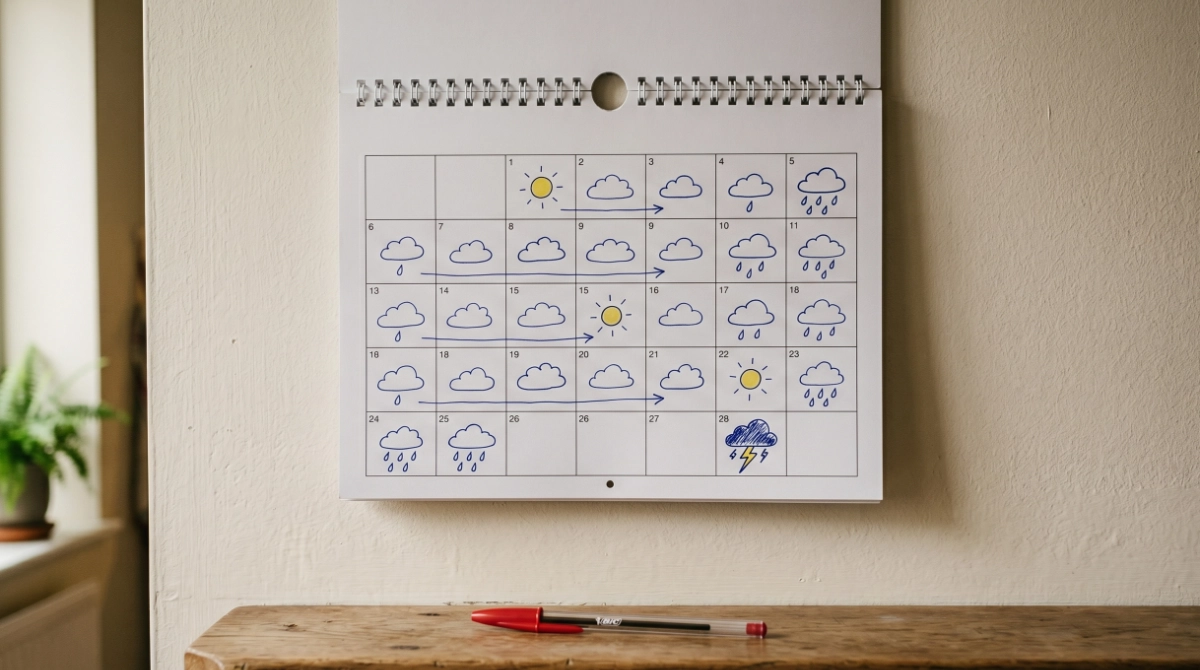
A 30-day month, visualised
Here’s what a typical month looks like for one severe ME/CFS claimant. The pattern doesn’t have to look like this exactly to score; it’s an illustration of the 22/6/2 distribution that arrives at descriptor f for most activities.
How do you quantify variation on a PIP form?
The single most useful technique on a PIP form for fluctuating conditions is specific frequency language.
Vague language gives the assessor permission to assume the better case:
- “It varies” → assessor reads “probably mostly fine”
- “Some days are worse than others” → assessor reads “occasional difficulty”
- “It depends on the day” → assessor reads “no consistent impairment”
- “Sometimes I can” → assessor reads “yes, can do”
Specific language closes that gap:
- “In an average month, around 18 days I cannot…”
- “For roughly two weeks each cycle, I am…”
- “On about 4 days out of 7 I require help with…”
- “For 3–5 days following any social engagement, I am…”
Three things to be specific about:
- How often the worse situation occurs - number of days per month, fraction of weeks, percentage of days
- What the worse situation actually looks like - not “bad day” but “cannot stand at the hob for the 20 minutes required to cook,” “cannot leave the bedroom,” “cannot speak”
- What the better days actually look like - preserving credibility without conceding ground; usually still showing significant impairment
You don’t need to be precise to the day. “Around 18 days a month” is more useful than “55%”, and both are more useful than “often.” The assessor needs enough information to do the 50% calculation themselves.
Worked examples by condition
ME/CFS
“My condition has a clear pattern. On around 22 days a month, I am housebound and largely bed-bound. I cannot prepare food, cannot manage my own washing or dressing, and am unable to leave the house. My husband does all of these. On around 6 days a month I can manage minimal self-care - short shower (sitting), simple meal (microwave only), within a strict pacing schedule. Doing so means I cannot do anything else that day. On around 2 days a month I can manage a short familiar journey - typically a 10-minute trip to the local Co-op with my husband. After any of these ‘better’ days I will be back in bed for 2–3 days afterwards.
I track my condition daily in a paper diary which I have included with this form.”
Bipolar disorder
“My condition cycles. Across an average year, roughly:
- 4 months in mild-to-moderate depressive states. Cannot prepare food without prompting, cannot wash regularly without prompting, cannot engage with friends or family beyond essential contact, cannot manage post or finances. Roughly the descriptor ‘needs prompting’ applies across most daily living activities. - 2 months in severe depressive states. Cannot prepare food at all, cannot wash for days at a time, cannot leave the house, cannot make any decisions. Most descriptors apply at the ‘cannot do’ or ‘needs assistance’ level. - 3 months in mixed or hypomanic states. Can technically perform activities but at significant risk to safety due to impaired judgement, racing thoughts, sleep deprivation. The reliability test (‘safely’) typically not met. - 3 months relatively stable on medication. Most activities possible with my husband’s reminders for medication, meals, and routines.
Across the year as a whole, I am unable to perform daily living activities reliably and unaided on the majority of days.”
Fibromyalgia
“My pain and fatigue fluctuate substantially within and between days. In an average month, I have approximately 15 ‘flare’ days where pain and fatigue prevent most daily activities - I cannot stand to cook, cannot manage stairs, cannot hold or grip reliably, and need my partner for washing and dressing assistance. I have approximately 10 ‘managed’ days where I can do basic self-care with aids (perching stool, dosette box, pre-chopped vegetables) but cannot manage cooking from scratch. I have approximately 5 ‘better’ days where I can do most things unaided, but doing so reliably triggers a flare within 24–48 hours.
The pattern is unpredictable. I cannot plan more than two days ahead. The reliability test applies - even on better days, I am not able to repeat tasks across a day or sustain them at a normal pace.”
Long covid
“My energy is severely limited and unpredictable. Post-exertional malaise (PEM) means that any moderate activity triggers a worsening of all symptoms 24–72 hours later. In a typical week:
- 4 days I am largely confined to home, in a recliner or in bed, unable to prepare food, unable to manage stairs, unable to engage with family for more than brief periods - 2 days I can manage minimal self-care and prepare a simple microwave meal, with rest periods - 1 day I can manage a short outing - typically a 15-minute walk locally with my partner - followed reliably by 2–3 days of crash
I track my symptoms and pacing in an app which I have included with this form. The reliability test applies across all activities - I cannot repeat any activity within a day or across days without triggering PEM.”
Multiple sclerosis
“My MS includes both fluctuating fatigue and progressive limitations. Fatigue is the dominant day-to-day variation. On most days - approximately 20 days a month - I cannot stand at the cooker for the time required to prepare a meal, cannot manage the stairs more than once per day, and require breaks during washing and dressing. On flare days - approximately 6 days a month - I am largely confined to one floor of the house and need assistance for almost all activities. There are around 4 ‘better’ days a month where I can manage routine self-care unaided, but doing so means I do nothing else; the activity uses my whole capacity for the day.
Heat, infection, and stress reliably trigger relapses. I have included recent neurology letters and my GP’s most recent fatigue management plan.”
What an assessor will look for
Two known patterns that disadvantage fluctuating-condition claimants in assessments:
- The “snapshot” question. “How was your journey here today?” “Tell me about your typical day.” These questions are designed to elicit a single-day picture - and a single-day picture, for a fluctuating claimant, can look much better or much worse than reality. The fix is to answer with the variation: “Today is one of my better days. On most days I would not have been able to make this appointment.”
- The “describe your typical day” trap. This is a question asked at almost every PIP assessment. Many claimants, asked to describe a typical day, describe a slightly above-average day because that’s what’s accessible to them mentally. The answer to give is structured: “Most of my days are X. There’s no single typical day. Around 60% of my days look like…” [detailed bad day]. “Around 30% look like…” [detailed medium day]. “Around 10% look like…” [detailed better day, with cost]. Any honest answer needs all three.”
This kind of structured response is harder than a single-day narrative, but it gives the assessor the same data the form is asking for.
A note on the diary
A symptom diary is the strongest evidence available for a fluctuating-condition claim. It does the 50% calculation for you, in a form the assessor can verify.
Two months of consistent diary entries (even one-line entries) is more useful than a clinician letter. The diary shows: 22 entries this month with severe fatigue preventing cooking; 14 entries of pain severe enough to prevent washing; 18 entries of panic preventing leaving the house. Numbers the assessor can read and rely on.
What to track:
- Date and time
- What you couldn’t do that day
- What help you needed and from whom
- Recovery time before and after any activity attempted
A simple paper notebook or notes app is fine. Some claimants use condition-specific tools (pacing logs for ME/CFS, seizure diaries for epilepsy, mood logs for bipolar). These add credibility but aren’t required.
We’ve covered evidence more broadly in our PIP evidence guide.
Free help and where to next
Fluctuating conditions are one of the areas where second-opinion help is most useful. The instinct to be modest is strongest precisely where it costs the most points.
- Citizens Advice - free PIP form help
- Scope - detailed PIP guides
- Fibromyalgia Action UK, MS Society, Action for ME, Long Covid Support - condition-specific PIP guidance from charities who understand the fluctuation problem
- Mind and Rethink Mental Illness - for fluctuating mental health conditions
Companion guides:
- The 50% of the time rule, with worked examples - the rule that scores variation
- The reliability test - the rule that scores “can but at significant cost”
- PIP descriptors explained: how points are scored - the foundational reference
- How to claim PIP for fibromyalgia - fluctuation-specific claim guidance
- How to claim PIP for ME/CFS - the textbook reliability-test condition
- How to claim PIP for long covid - newer, more contested, evidence-building focus
If you’d like a tool that walks you through the form with the 50% rule and the reliability test built in, including optional AI rewriting that translates honest variation into descriptor-aligned language, you can start a claim with us. You stay in control of every word that appears on your form.
This page describes PIP rules as they stand in 2026. The 50% rule and the reliability test are set out in The Social Security (Personal Independence Payment) Regulations 2013, regulation 7 (retrieved May 2026). This is general information, not legal or benefits advice - your award will depend on your specific circumstances.